A haunting photograph of an African-American boy dressed in a military uniform tells a story about two different yet interconnected struggles: the Vietnam War, a war widely regarded as a “white man’s war” and the battle for racial equality at home in the United States.
The soldier is Skip Dunn, childhood friend of acclaimed author and journalist Wil Haygood, and is immortalized on the cover of Haygood’s latest book, “The War Within a War: The Black Struggle in Vietnam and at Home.”
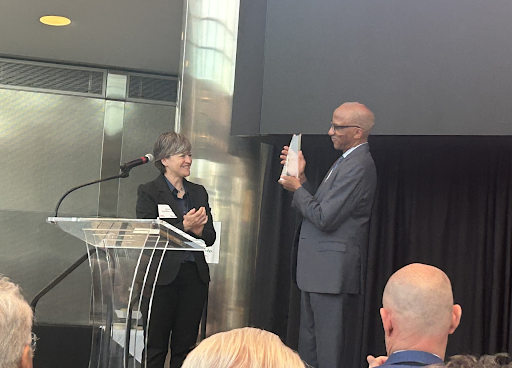
On Wednesday, April 8, the University of Denver welcomed Haygood to present this year’s Estlow Lecture, honoring him with the Anvil of Freedom Award. During the lecture, Haygood discussed his latest book, which focuses on the experience of Black Americans who fought during the Vietnam War and the ongoing struggle for freedom they faced at home. He also spoke on the current siege of academic research and journalism in the United States.
Haygood was given a warm welcome by several DU faculty members, including Dr. Sahara Byrne, the dean of the College of Arts, Humanities and Social Sciences (CAHSS), Dr. Lynn Schofield Clark, the director of the Estlow International Center for Journalism and Damon Vine, director of Veteran and Military Services. Brandon Beck, a current DU graduate student and veteran and Katie Mittelstadt, a current DU history major who recently completed her senior thesis on Black servicemen in Vietnam, also helped welcome Haygood.
Over his career, Haygood has traveled internationally, interviewed iconic figures such as James Baldwin. He has also worked with Oprah Winfrey on his nonfiction book turned movie, “The Butler,” which chronicles the life of Eugene Allen, who served as a butler under eight U.S. presidents.
While discussing the wisdom gleaned from his long career, Haygood discussed the current political climate and war in Iran, drawing comparisons between recent events and the important histories he covers in his book.
“I’ve been on more battlefields than the man that sent us to war,” Haygood remarked, referencing his own time as a foreign correspondent.
The book begins with a quote from American writer and civil rights activist James Baldwin, which Haygood read aloud, “Long, long before the Americans decided to liberate the Southeast Asians, they decided to liberate me: my ancestors carried these scars to the grave, and so will I. A racist society can’t fight but a racist war – this is the bitter truth. The assumptions acted on at home are also acted on abroad, and every American Negro knows this, for he… was the first ‘Vietcong’ victim. We were bombed first.”
This stirring quote encapsulates the theme of Haygood’s book, which focuses on seven Black soldiers who served in Vietnam. It also tells the stories of a concert pianist and a reporter who both played significant roles in the war. The book includes the often overlooked stories of Black women in the war, including Dorothy Harris and Phillipa Schuyler.
Haygood’s argument revolves around the experience of Black military personnel abroad and the violence back home in the United States. Skip Dunn, Haygood’s childhood friend and neighbor who served in the Marines, was injured twice during the war and was summoned home because his mother had been murdered by his stepfather.
This was Haygood’s personal experience with the war within a war; Skip Dunn, who served in a war for a country that violently discriminated against him and had to return to that country where that violence was in his backyard.
“Father, father, we don’t need to escalate, you see, war is not the answer, for only love can conquer hate,” sang Haygood, who left the audience with a humble performance of Marvin Gaye’s “What’s Going On.”
Haygood’s conclusion also served as a reflection on the current situation our nation faces, as we continue to ask Marvin Gaye’s age old inquiry.
You can purchase the book here.