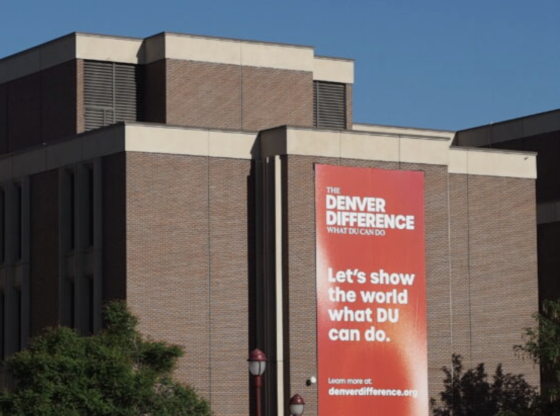
The University of Denver has many excellent departments, programs, faculty, staff, donors and initiatives that come together to create “The Denver Difference.” A funding campaign, but more importantly, a genuine selling point and multidimensional transformation of higher education that sets us apart from Colorado state universities and other private universities.
Unfortunately, due to existing and ongoing enrollment declines, increased financial issues and personal opinions from certain administrators, one of the necessary elements central to DU’s campaign is at risk of being massively downgraded: religious studies.
For those outside of religious studies, you may be wondering why it is central to The Denver Difference? And what even is religious studies anyways? Despite being unable to provide an answer to the long-debated latter question, I can say with certainty that religious studies can be nearly anything because it is inherently interdisciplinary while religion is everywhere and affects everything including DU, especially in ways you do not always see.
For reference, Denver is religiously diverse and DU has many religious affiliations as seen with those student organizations and others like the South Asian Student Association, Native Student Alliance and African Students United. These diverse demographics affect life both on and off campus, so providing opportunities to learn more about the religions around us empowers the DU community to better serve the public; a core element of The Denver Difference.
The Department of Religious Studies (RLGS) embodies doing public good. They educate people about religion beyond DU’s campus through their annual James Kirk Lectureship, public panels like the recent “Failure and Resilience in Academia,” public-facing scholarship from its students and faculty, and participation in or hosting of academic conferences. Simultaneously, RLGS gives people actionable skills necessary for navigating the religious complexities involved in the goals of The Denver Difference, including improving the future of the human condition, thriving in a rapidly changing world, challenging conventional thinking and benefiting societal change.
Religious studies is necessary for these goals because it is inherently interdisciplinary, an academic approach DU seemingly holds close since the word appears dozens of times on DU’s websites and marketing materials. But to truly be interdisciplinary, DU must maintain religious studies so students, no matter their major/program, can continue learning relevant and interdisciplinary information for themselves through FSEM, ASEM and RLGS courses or other work with religious studies faculty.
The importance of this rests in the fact that almost any research even beyond the humanities is affected by religion in some way. In the simplest terms: social work and psychology require religious knowledge for proper treatments and patient care; business needs to know the religious lenses through which their consumers view advertisements or products; STEM and education are impacted by how religious beliefs shape their public and political acceptance; global and public affairs must navigate the international religious complexities of the world; and law deals with religion in everything from individuals and motivations, to institutions and court cases. Religious studies helps us better interpret many kinds of data, plan future research and work around religious influences on funding or social/political trends and argue the relevancy of our research to wider audiences.
Therefore, having the ability to better understand religion ensures we can embody The Denver Difference and aligns with DU’s overall research focus on “Innovation for the Human Experience.” This involves collaboratively addressing the three DU Grand Challenges to improve daily living, increase economic opportunity, and advance deliberation and action for the public good. This is achieved in part by empowering students through the 4D Experience to “Deepen Intellect, Develop Well-being, Discover Character, and Design Careers & Lives of Purpose” as they engage with curricular and co-curricular experiences locally and abroad. All amazing things.
Yet, how can we, as a university, successfully accomplish any of these without the knowledge provided by religious studies? Especially at a time when multiple countries, including the U.S., are waging wars in the name of religion; when politicians across the world from the U.S. to India to Kenya are invoking religious iconography and rhetoric for political power; when religion is being used to dismantle and underfund education and science; and when religious perspectives justify ongoing removals of human rights and economic opportunities for certain people. So ask yourself two questions: Can we be The Denver Difference without the interdisciplinary faculty, department and knowledge central to each of its goals? And is it even good financial foresight for DU to think about reducing religious studies at a time when people need it, and will likely want it most?
I acknowledge the discipline, just like much of the humanities, has a hard time being commonly understood or “selling” itself in a country dominated by flashy but unstable and inconsistent “get rich quick” careers. So I understand why some at DU may think it is better to fix enrollment issues by focusing on programs/departments that provide this same short-term and surface-level appeal, even though these have been suffering too. However, the reality is that DU would be more appealing to a broader number of prospective students by enhancing our college’s internal collaboration with each other and marketing the deeper-level interdisciplinary and interpersonal benefits of religious and humanities education for campus life, future careers and other university programs.
This approach would also bring these transformative, unique DU strengths to the forefront of The Denver Difference campaign as it works toward the $1B goal. Doing so diversifies and strengthens DU’s educational potential in-line with its brilliantly established interdisciplinary and collaborative initiatives without consolidating our programs to a degree people have a harder time understanding their potential. RLGS at DU has already addressed related issues by renaming its main program to “Religion, Culture, & Society” which speaks to its interdisciplinary nature and says more about what “religious studies” really does than those two words alone.
Maintaining and even enhancing religious studies at DU, ensures students and the public can continue to critically understand their own religious life, religious differences, religious influences around the world, and how religion affects our daily lives — even in seemingly unrelated areas.
Plus, religious studies empowers people at DU in more ways than could be fully addressed here. It promotes DU’s commitments to accessibility, inclusivity and tolerance for those on and off campus, especially as they relate to cultural/religious differences. It enhances students’ study abroad 4D experiences by deepening cultural/historical knowledge and respect for others. It also helps produce world-class interdisciplinary scholars through the Joint Doctoral Program with Iliff School of Theology, whose diverse work exemplifies The Denver Difference.
To conclude, the Denver Difference states, “At the University of Denver, we took a good, long look at the future of higher education. And thought: we can do better.” But without serious investment into the necessary interdisciplinary insights of religious studies, we cannot do better. Nor will DU achieve the important goals of its campaign, since without religious studies we lose a central element to everything DU stands for. It also risks losing prospective students, who may instead continue flocking to state schools that offer religious studies and other humanities programs they find appealing.
When we recognize the importance of religious studies and emphasize its usefulness to other programs, professional careers, and personal development, we will not only renew people’s interest in DU but set our university further apart from the competition.
This is The Denver Difference.
______________________________________________________________________________
If you want to learn more about how religious studies broadens the university’s appeal or benefits other programs and The Denver Difference, any Department of Religious Studies faculty will gladly meet with you. Or read the statements below from several DU religious studies alumni and students.
“Without religious studies it will inevitably impact DU’s international student enrollment because the students who are interested in seeing, studying, or incorporating aspects of Hinduism, Islam, Buddhism, or other global religions from their home countries will be less interested in coming here if they are not represented.” – International Religious Studies Graduate Student
“As a recent alumnus from the DU and Iliff Joint Doctoral Program my ability to use the skills I have learned in DU’s religious studies program has allowed me to be culturally competent in my work across many universities.” – Alum with a Religious Studies PhD
“Without religious studies I would not have ever made it to a PhD in religion. I came into higher education as a first-generation student who did not know about the various college career options which is why I was originally pre-med. However, being required to do a humanities class about religion made me fall in love with the study and now I hope to become a professor of religion for future generations, but for that to happen we need religious studies programs to stay intact.” – Religious Studies Graduate Student
“As a DU alum who has continued their academic career in Religious Studies post-graduation, I believe that Religious Studies is necessary because we offer a perspective on the world which other departments in the social sciences and humanities often lack. I decided to major in religious studies because I love to learn new things, and after taking a few courses it dawned on me that religion is something we actually know very little about. For how impactful it is, the study of religion is often dismissed as archaic or biased, and I think there is a large misunderstanding of what religious studies is. But it’s because of that misunderstanding that the discipline is necessary. Religious studies isn’t just Bible study, it encompasses sociology, language translation, anthropology, international politics, history, and everything else under the sun, but filtered through the lens of religion. Arguably, that makes it the most important discipline in the world but it gets ignored and written off. The religious studies department at DU is exemplary of all the best qualities of this discipline. All the faculty are knowledgeable and deeply passionate about the work that they do and the field they get to contribute to. They provided a lot of support to me which my friends in other departments weren’t getting with their advisors. They encourage creativity and innovation, and I think if DU really wants to place itself as a competitive school which fosters a lifelong love of learning and community engagement then we need more faculty like them. Their encouragement and excitement at my successes and consultation of my failures made me excited to go to class every morning. While the classes were challenging, I never wanted to not go because there was always something new to learn whether it was dissecting the religious system of sci-fi movies, or analyzing the role of religion in hip-hop lyrics. Religious Studies truly offered something for everybody, and I wish everyone got to experience this department the way that I have.” – Undergraduate Religious Studies Alum
______________________________________________________________________________
— David C. Kemp, Joint Doctoral Program in the Study of Religion