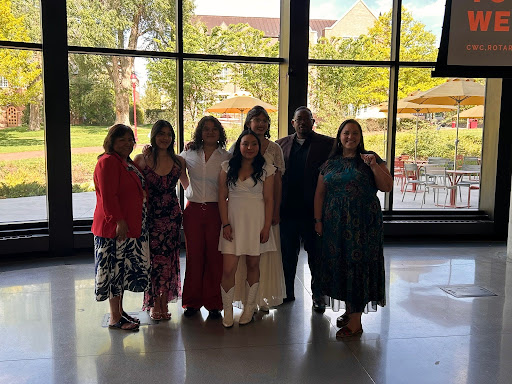
Last Thursday, the Incarcerated Artists Alliance (IAA) hosted its second annual spring exhibition at the Sturm College of Law.
Over 250 guests across the Denver metro area gathered to celebrate the works of currently and formerly incarcerated artists in Colorado. The organization’s spring exhibition saw members of the Denver community engaging with emotional expression produced by artists whose talents and passions are often overlooked.
The event commenced with a brief cocktail hour where guests browsed the displayed works and mingled with fellow attendees. Guests were eventually invited to take their seats, while artists, or representatives speaking on behalf of those currently incarcerated, showcased various media including spoken word poetry, acrylic paintings, bead art and more.
Claire Francis, DU law student and sitting president of the IAA, explained in her opening remarks that the IAA aims to provide a forum for incarcerated individuals to create and display their art. The organization’s primary focus is educating incarcerated artists on their intellectual property rights.
Francis explained that as far as they know, the IAA is, “the only group in the country working at the intersection of intellectual property law and advocacy for incarcerated people.”
Many incarcerated people don’t know that they own the copyright to their own work as soon as pen touches paper, and have limited avenues for learning about their legal rights. The IAA is pushing against this power imbalance between inmates and institutions, inherently prominent in the United States prison system, that makes exploitation especially easy.
Sturm College of Law Dean, Bruce Smith, highlighted that as few as eight sessions of art therapy have shown to significantly reduce depression, improve sleep patterns and increase sociability.
Creating art is an outlet where incarcerated people can express their emotions. It involves motions that aren’t restricted by others in an environment where so much is out of their control. It’s an opportunity to prove that hope survives even behind bars.
Featured artist Dale Bruner advocates for the power of artistic expression, “art can leave the walls even when he can’t.”
Among the attendees at last Thursday’s exhibition was Michael Diaz-Rivera, a local case worker who had attended simply out of personal interest. During the cocktail hour, Diaz-Rivera drew a small gathering of four or five guests as he recounted a striking coincidence: one of the highlighted artists, Terry Gaines, was his elementary school classmate and first best friend.
Diaz-Rivera appeared stunned. After many years without contact, in part due to Gaines’ incarceration, the two pals were reunited. Except, they were not standing face-to-face, but rather, brought together through Gaines’ art.
Diaz-Rivera’s unexpected reunion is exactly the impact the IAA was hoping to make. As the organization continues to grow its mission remains clear: promote artistic expression, advocate for intellectual property rights and cultivate a community of hope. Their spring exhibition certainly suggested they are well on their way.