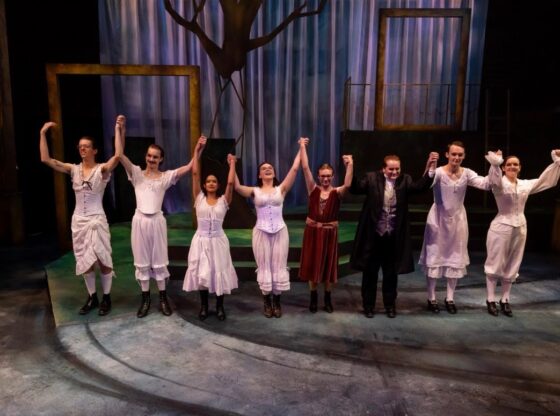
On Thursday, Nov. 5, The Lamont School of Music hosted excited audience members and musicians to celebrate classical and modern hits.
The choir, dressed in formal black attire, started off the show by performing a variety of songs. Second in the program was Benjamin Britten’s Afternoons, Op. 7, No. 3 – Cuckoo, a thematic description and staple of Wes Anderson’s Moonrise Kingdom.
Then came Johann Sebastian Bach’s “Wir eilen mit schwachen doch emsigen Schritten” a duetto cantata written to be performed during Trinity XIV, the fourteenth Sunday after the Feast of the Holy Trinity in the Western liturgical calendar. The high pitched baroque singing compliments the cantata’s theme of the search and hope for God even when addled by pain and weakness.
Performed later in the program was Shenandoah, a traditional folk song written by James Erb. Erb was an incredibly esteemed composer and founder of the Richard Symphony Orchestra, the largest performing arts organization in central Virginia.
An interchanging rotation of composers commanded each piece. Lauren Black, composer on Britten’s Cuckoo, was given raucous applause upon taking stage and precisely controlled the playing of the simple yet reflective piece that describes a bird’s routine throughout the months of the year. “In June I change my tune; / In July Farfar I fly;” were among some lyrics executed to near perfection by the composer’s direction.
The choir performed a variety of different songs, stretching far from the early performed “Cuckoo.” James Erb’s arrangement of the Civil War era choir standard is a lasting testament to his legacy as a choir conductor, written while working as a conductor at the University of Richmond.
Latvia’s ?riks Ešenvalds and his wonderful “Northern Lights” was featured mid-way through the performance and utilized chimes and crystal glasses to invoke a feeling of fear and wonder experienced by the song’s speaker: a sailor writing a diary entry upon seeing the northern lights in the sky.
The imagery of the song’s lyrics, reflecting Latvia’s folk lore in its description of the night sky as old warriors in battle, acts as a reminder of what nature can make us feel and reflect upon in its grandest moments. The sailor remarks, “How many nights have we seen the warriors fighting against the north? / Oh, I saw the warriors fighting;”
Immediately following this was K?stutis Daugirdas’s Plaudite Psallite. The song moves piano player J. David Reid, who is new to the Lamont School of Music, to vocal performance. Reid’s voice comes through just as clearly as his piano playing and compliments a bountiful and celebratory rendition of a latin text that was originally published in 1597 in Symphoniae sacrae I.
Before “Plaudite Psallite” and “Northern Lights” was a piece featuring guitar playing from Aidan Wiley Lippke entitled “Odes of Love”, written by Santiago Veros. The energetic song allows a subtle backdrop of guitar to poke through the booming choir. While the choir navigates the audience through the song, the guitar provides support for the choir and piano. Pianist David Reid floats melody on top of all, and creates a musical space far different from many that are created at the Lamont School of Music.
The emotion of the concert was incredibly impactful. Audience members may have even found themselves tearing up during Britten’s “Cuckoo”.