As audience members entered Byron Theatre, a curious scene was portrayed on stage: a simple oak tree. Once the lights went down, the audience was transported back in time to the Elizabethan era and met Orlando, a 16-year-old nobleman, who is an aspiring poet and wants to become a member of Queen Elizabeth I’s court.
For the next 90 minutes, the audience is taken on a fantastical journey across centuries as Orlando explores love, loss and the subjectivity of time (the play begins in the late 16th century and ends in the 20th century) ending with a 36 year old Orlando.
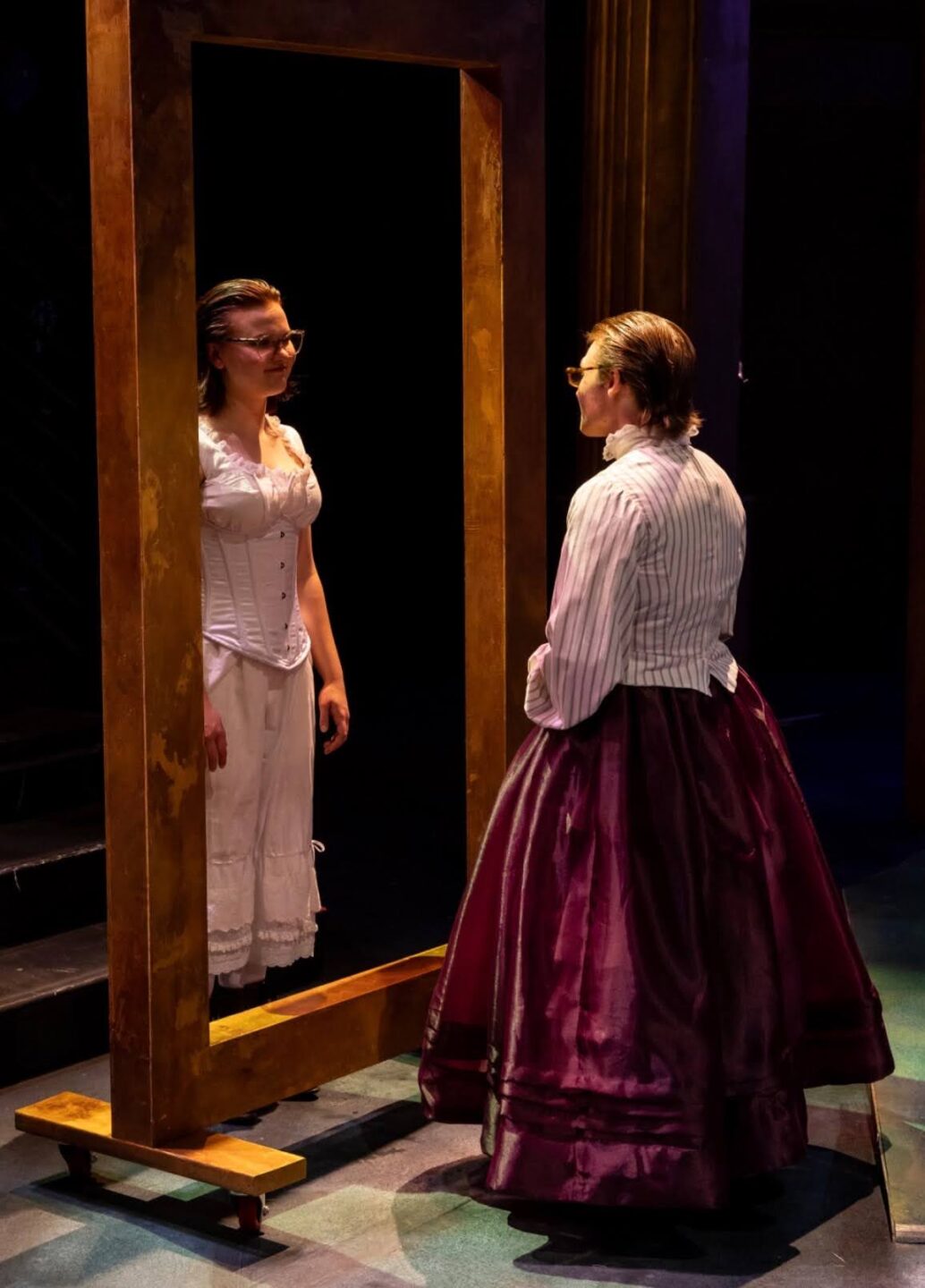
The play explores themes of gender fluidity and gender as a mere social construct. At the end of the first act, Orlando falls asleep in Istanbul and wakes up to find that he has become a woman. The rest of the play showcases Orlando navigating through the 18th, 19th and finally 20th centuries with a female identity.
“Orlando” is written by Sarah Ruhl who adapted the idea from Virginia Woolf’s 1928 novel with the same name. Woolf’s novel is regarded as a “masterpiece of modern queer fiction” for gender exploration and the fact that it was written as a love letter for Woolf’s friend, muse and partner, Vita Sackville-West.
“This is the fastest Virginia Woolf ever wrote a novel, and it is so full of love for Vita [Sackville-West]. Orlando is based on Vita and you can just tell because of how much everyone in the world constantly adores Orlando,” said fourth-year history and theatre major Evie Becker.
DU’s version, which premiered from Oct. 29-Nov. 1, was wonderfully fun to watch. The ensemble, who inherit several different characters across the centuries, are entertaining—and naturally hilarious—but have no problem toning it down for the play’s more somber moments, like when Orlando is abandoned by his lover, a Russian princess named Sasha.
Instagram // @rdgphoto_colorado
Becker and the Clarion’s own Weston Tybor, a fourth-year English and business analytics major, both played Orlando in the first and second act, respectively.
Becker’s portrayal of Orlando as a boyish romantic (yet at times as a downright womanizer) made audiences connect with the character in the first act of the play. Body language and a wide range of facial expressions made the character feel much more real.
By the time Orlando transforms into Lady Orlando, you are sad to see Becker go. But Tybor makes up for it in every way, giving the audience an equally endearing and fun performance to the end of the show.
Becker also had the opportunity to work as a dramaturg for the show, which is not typically standard because of how the role of actor and advisor in a show contradict. But it is something they are incredibly grateful for.
The themes of “Orlando” resonated with both the audience and cast, making everyone reflect on the subjectivity of time, change and love.
“To me, [“Orlando”] just wants us all to understand how valuable it is to love despite change.”