Map courtesy of Zoe Klawetter.
Editor’s Note: The Clarion conducted this investigation upon the discovery of the proposed fees on the DU Passport website. The map was created to highlight the affected programs. These fees have since been cancelled as of Oct. 12, 2025.
The University of Denver has long promoted a global education as a vital part of the 4D Experience. They advertise that over 70 percent of undergraduate students study abroad at 150 different programs. And, for as long as this has been a part of the DU experience, it has come with a promise: study abroad at no additional cost.
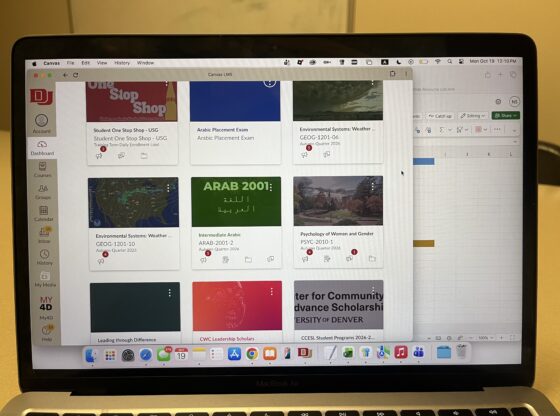
However in the last few weeks, fees appeared under program overviews on the DU Passport website, listed as “Study Abroad Program Fees.” Those fees came in three tiers: $2,500, $5,000 and $10,000. For any program they were applied to, they were charged in addition to DU tuition, technology fees, housing and meal plans if applicable.
These fees were cancelled on Oct. 12 in an email sent to the Clarion.
“The University of Denver is not moving forward with the proposed study abroad fees for 2026–27,” Associate Vice Chancellor of Communications & Issues Management Kira Good said. “Leadership heard from our students and understands how the idea of added costs caused concern and uncertainty about participation in global learning next year.”
Second-year Jocelyn Scanlon was looking at study abroad options during the week of Sept. 22. She was heavily considering the John Cabot University program in Rome. A week later, she reopened the program overview and noticed a $10,000 Study Abroad Fee had been added.
“I was kind of shocked. It just didn’t align with anything we’d been told…finding out that the additional fee is not covered is upsetting. It was one of the reasons I chose this school,” said Scanlon.
After the latest announcement, the John Cabot University program will return to its original price. But as of now, the fees still appear on the DU Passport Website.
“I am very excited. I’m going to be within walking distance of the Colosseum,” Scanlon said. “I spoke with individuals who are very passionate about changing things for the better and I think their voices contributed to this outcome.”
Throughout this process, no formal announcement was made to the student body or prospective families in regard to the new fees.
In an email sent to admissions staff, which was shared with the Clarion by a student employee who wishes to remain anonymous, the changes were acknowledged, but an intention to share them was not put forward.
“I think this context is important for the admission counselors and tour guides to know, but we don’t necessarily need to share these details with families,” said Vice Chancellor of Enrollment Management Todd Rinehart. “Tell the [tour] guides to not panic and hold off on communicating any of this until we can have another meeting with them to share our talking points.”
Vice Provost for Internationalization Uttiyo Raychaudhuri stated that he did not want to change the messaging at all.
“Study abroad at DU is exactly the way it is, it used to be, and it was promised to the students,” said Raychaudhuri.
Raychaudhuri cited these fees as a necessity to cover rising international costs around the programs they were associated with.
“Costs of everything are really going up, so there are a group of programs, which are out there, which are more expensive. We had the choice of not having those programs…If [students] wish to pay additional costs to go on those programs, they can go on that,” Raychaudhuri said.
Raychaudhuri believes it is unfair to students attending less expensive programs to pay the same amount as students attending programs with higher costs.
“I think it’s also a question of equity; that we have a large group of students who are coming from all kinds of backgrounds, right? It would be wrong to expect that there will be a select group of students going on a very expensive program that DU will subsidize for them at the backs of someone else,” said Raychaudhuri.
According to Raychaudhuri, many programs attempted to increase their prices in January of last year for the students who are currently abroad, but the Office of International Education (OIE) was able to put off the increase by negotiating discounts.
“We negotiated to the tune of millions of dollars down,” Raychaudhuri said.
Despite last January’s scrambling, Raychaudhuri said that there was no way to predict the “very elevated” prices that they are seeing this year.
James Antonio, the Director of U.S. Study Abroad Admissions at John Cabot University, which was a tier-three program, told the Clarion that the university has not seen drastic increases in tuition prices.
Other American universities with renowned study abroad programs have felt the effects of rising costs, but with varying responses. At the University of San Diego (USD), 83 percent of students study abroad with over 80 programs to choose from.
“Costs for study abroad have increased over the past few years,” said Director for International Study Abroad at USD Lindsay Allen. “Inflation, fluctuations in currency exchange rates, rising airfare, and increased local costs in host countries have all contributed to the overall rise in program expenses.”
While USD deals with similar issues, they make it a priority to educate students on the costs involved.
“Transparency is key. We post all program budgets online, outline what each fee includes, and discuss potential challenges during advising sessions and pre-departure orientations. We also provide financial planning resources and one-on-one support to help students understand their options,” Allen said.
The University of Denver continues to raise costs in similar ways, with the cost of attendance increasing 3.54 percent last year.
However, cost increase is not the only factor that affects the OIE budget. DU tuition is currently $20,616, but the OIE receives $8,195 to send each student abroad. The rest is credited to the DU discount rate and operations price.
The DU discount rate is currently 52 percent, meaning that the average student pays 48 percent of tuition due to their financial aid. In the proposed budget for the 2025 fiscal year, DU was set to give out $175.9 million in institutional grant aid. Of this, $154.7 million was unfunded. This figure has increased 80 percent since 2016, when about five percent of institutional grant aid was unfunded.
This unfunded aid creates a gap between total DU tuition price and the money available for each student, which comes as DU faces recent budget issues.
“This is absolutely independent of any of this [budget issues],” Raychaudhuri said. “DU has made a choice to prioritize good global opportunities for students.”
To make up for expensive programs, DU is now looking to have its own programs across the world.
“We are working on an initiative in London to have a DU London program, which can be affordable,” Raychaudhuri said.
While students studying abroad next year are safe from the added fees there is no knowing how rising international prices and the declining OIE base price will affect DU students in the future.
“We’re continuing our long-standing commitment: every student who wants to study abroad will be able to do so at the DU tuition rate. While we continue working to expand program options and capacity, we are pausing any fee changes to ensure that promise is delivered,” said Good.