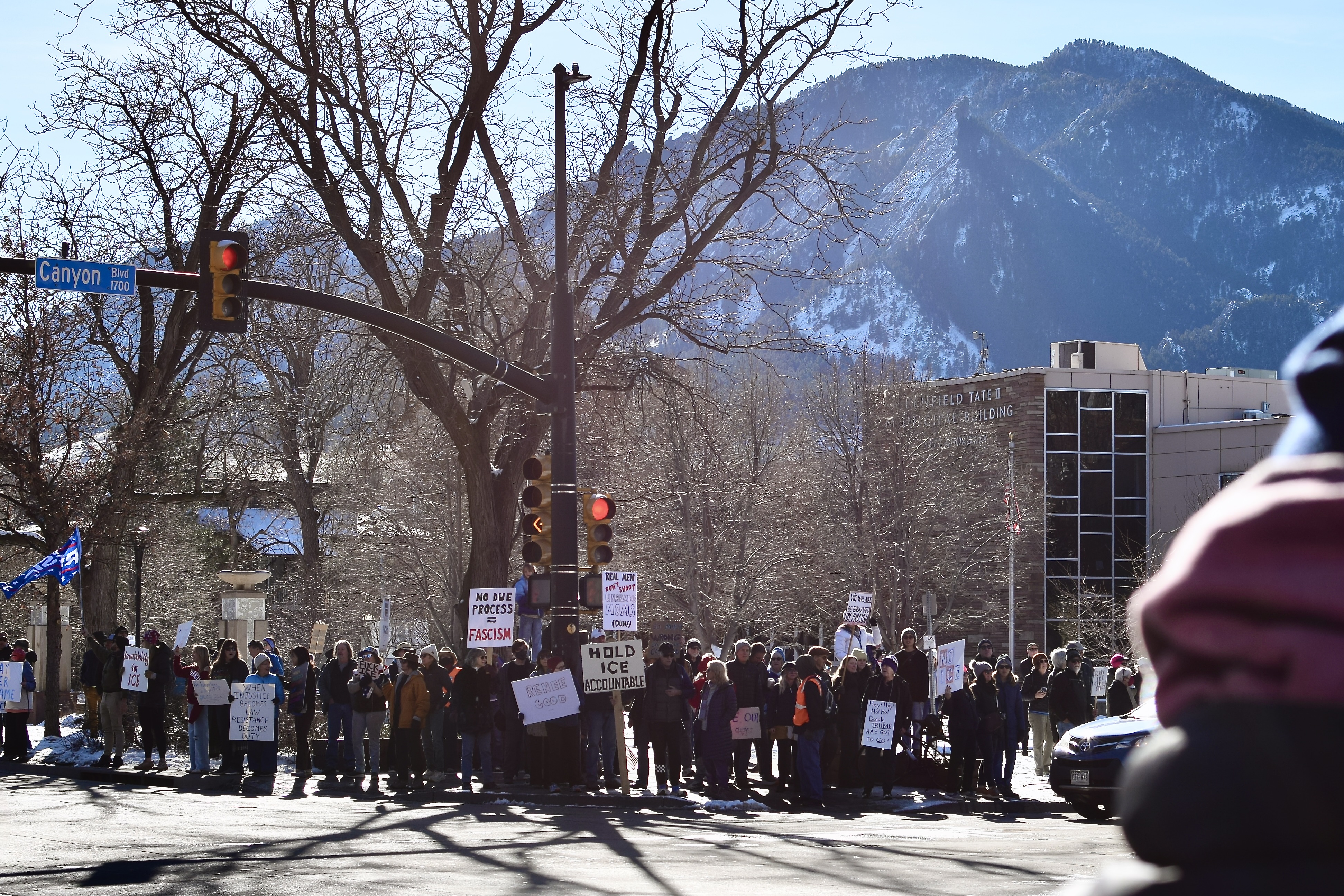
A national surge in demonstrations against Immigration and Customs Enforcement (ICE) continued last weekend, with protests commemorating a nationwide strike on Friday, Jan. 30 and a string of marches and other rallies taking place around the country continuing on Saturday and Sunday.
In Denver, thousands assembled in La Alma-Lincoln Park on Jan. 30, with many local businesses closing their doors in support of the demonstration. The nationwide strike called for “no work, no school [and] no shopping” to condemn the agency’s actions in Minnesota last month.
The protests come amid national outrage over the fatal shootings of Minneapolis residents Renee Good and Alex Pretti, detention of five-year-old Liam Conejo Ramos and his father and a surge in immigration enforcement operations across the country.
At the event, several speakers referenced Ramos, Good and Pretti, noting the latter two had ties to Colorado. Good was originally from Colorado Springs, while Pretti’s parents currently live in Arvada.
In 2026, at least eight people have died in ICE custody or have been killed by ICE officers. At least 32 people died in ICE custody in 2025, making it the agency’s deadliest year in two decades.
In addition to Good and Pretti’s shootings, three people have died in ICE custody while at hospitals. Luis Gustavo Núñez Cáceres, a Honduran man, died on Jan. 5, Luis Beltrán Yáñez–Cruz, also from Honduras, died on Jan. 6 and Parady La, a Cambodian immigrant, died on Jan. 9.
Two men have died at an ICE facility in El Paso, Texas, called Camp East Montana. Geraldo Lunas Campos, from Cuba, died on Jan. 3 of asphyxia after he was held down by guards in what has been ruled a homicide. Víctor Manuel Díaz, from Nicaragua, died in what ICE officials said was a “presumed suicide” on Jan. 14. His family disputed the statement, calling for a full investigation into his death.
Also on Jan. 14, Heber Sánchez Domínguez, from Mexico, died at the Robert A. Deyton detention center in Lovejoy, Georgia; ICE stated that his death is under investigation.
“That could have been me, that could have been one of you,” said Donny Torres, an organizer with the Native American-affiliated group Rise and Represent. “I know I won’t let their names be forgotten, and I know you won’t either.”
The protest included over 1,000 students who walked out of schools to the Capitol building before joining the protestors in La Alma-Lincoln Park. With them were more than 1,100 teachers — 20 percent of the workforce — who called out, forcing several school districts to adjust operations for the day.
Denver Public Schools closed six schools and announced a two-hour delay for others, though it cancelled all early childhood programs and center-based programs for students with disabilities. Aurora Public Schools and Adams County School District 14 both closed schools and after-school programming due to staff absences.
Boulder Valley School District remained open, but had schools operating on reduced staffing after nearly a quarter of its teachers called out.
Several students at the Jan. 30 rally cited parents and friends as their reasons for walking out of school. Following the Jan. 30 event, protestors marched down 14th Street in Denver from the Capitol building on Jan. 31. Further anti-ICE action is planned for February and March.