Editor’s Note: The views and opinions expressed in this article are those of Ethan Turner and do not necessarily reflect those of the Undergraduate Student Government (USG) or the University of Denver.
Undergraduate Student Government (USG) bylaws prohibit USG representatives from making statements on behalf of the larger student body. The bylaws further define “statements” to include comments made by the Executive Cabinet in connection with their official titles. Thus, all statements made by USG representatives must be approved by a majority vote in the Senate.
On Oct. 27, The Clarion agreed to provide only the direct quotes for Senate review, under the condition that these comments be presented to the Senate in a pass/fail resolution, without the option to amend.
On Oct. 28, USG Senate voted to approve the statements without amendment. Of those present, 15 representatives voted in favor of the resolution, two abstained and none voted against. Due to the timing of the Senate meeting, this article was held for publication until Nov. 3.
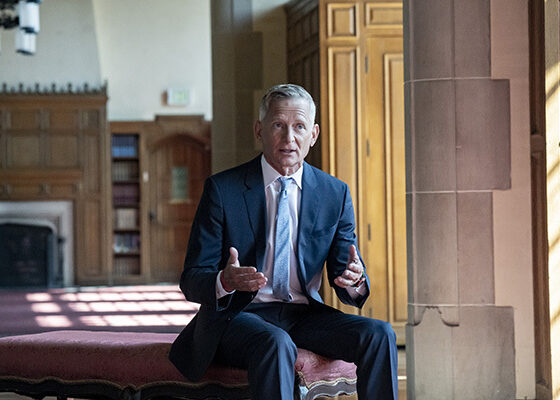
As a Undergraduate Student Government (USG) presidential candidate last spring, Ethan Turner promised to amplify student voices, connect campus communities and increase transparency between university stakeholders.
Nearly a third of the way into the school year, now-President Turner acknowledged that while he and Vice President Noura Ali Abid have made progress, they still have work to do.
“I think that there are still a lot of ways that we could be reaching those three pillars that we aren’t necessarily doing yet,” Turner said.
Many of their initiatives are in the early stages, Turner explained, such as programs to formally gather feedback from registered student organizations (RSOs) and a way to coordinate with them directly through USG’s Diversity Committee.
Turner sees forming stronger connections with RSOs as an opportunity for USG to engage with the student body in a way it previously hasn’t.
“Something that we’re really exploring this year, and that I think USG hasn’t historically pulled on very well, is those relationships with our RSOs,” Turner said.
While USG has been working to improve transparency between students, their representatives and administrators, Turner believes that they’re struggling to define their role in informing the community without becoming spokespeople for the administration. Ultimately, Turner said, his responsibility is to the students he represents.
“When is it our job to disseminate that information? And when is it theirs? That’s a huge piece of promoting transparency, and we can’t be their PR department,” he said. “I think that that blurs the lines of, do we work for the chancellor? And my firm answer is no.”
Turner continued to emphasize the balance between updating students without becoming their only source for information.
“We are not a mouthpiece for the administration,” he said.
Another ongoing challenge for USG is communicating its role to students, an issue Turner previously identified during his campaign.
“Students actually don’t know what we do in a lot of ways, and I think that is for a couple reasons – chiefly, because we don’t really talk [to students] about what we do,” Turner said.
His own role, he explained, is to bridge that gap, as well as the gap between students and administration.
“My job is, one, to operate a functional student government that serves the students, and two to make sure that I am doing the most I can to collect student feedback and to bring it to administrators,” he said.
Turner is aware that some students have criticized the speed and responsiveness of USG, especially when addressing rapidly unfolding events on campus.
“I think that criticism is totally fair,” Turner said. “It is frustrating to me when I hear about changes that are happening that students are very concerned about, and then I go and show up to our Senate meetings, and we’re talking about other bills that are unrelated to those student concerns.”
However, Turner noted, the structure that he believes can make USG initially slow to respond is the same structure that enables them to ensure that their statements are substantive, not symbolic.
“I would rather take longer and have something to show for it than be too quick to respond to something and have those be empty words,” he said.
Many of the conversations Turner has had in USG this quarter have been focused on the dismantling of the Cultural Center and the implementation of the new Division of Community Support and Engagement.
Turner said that he and several USG representatives feel that “students are not being told about these changes in a way that is supportive to students.” USG has not made an official statement regarding these changes.
“We have said to administrators multiple times that we don’t understand what got carried over from the Cultural Center to the Division of Community Support and Engagement and what was moved elsewhere. And if we, as the people that are meeting with Student Affairs on a bi-weekly basis, don’t understand those changes, how do I expect [students] to understand where to go? We’ve pretty firmly pushed back on administrators saying that it’s not necessarily their job to communicate those changes, because I think it is,” Turner said.
While USG has plenty of what Turner called “soft influence,” he believes their direct power to make change is often limited, especially when in opposition to the administration.
“At the end of the day, do administrators always implement exactly what we tell them we want to see? No. But they, at the very least, entertain a lot of conversation about it. Where I think our hands are tied is that at the end of the day, we aren’t administration. I can tell the Chancellor’s Office 100 times that students are feeling this way and students specifically want to see this or this. I can’t make that happen. I have no power to make that happen,” Turner said.
Before Chancellor Jeremy Haefner’s State of the University address on Oct. 30, The Clarion asked Turner for his perspective on DU’s current condition.
“I’m worried about the university,” Turner said.
Turner believes that the relationships among students, staff, faculty and administrators are fractured, and that distrust from those rifts is impeding the community’s ability to have productive conversations.
“While I’m worried about the university financially and its place as one of thousands of private institutions, what I’m more worried about is the constituents of the university being able to engage in discourse that pushes us forward,” he stated.
Turner said the remedy isn’t to overlook criticism from the community and referenced the votes expressing no confidence in Chancellor Haefner’s leadership passed by CAHSS faculty, Faculty Senate and the student senate of the Sturm College of Law’s Student Bar Association.
He stated that USG is in conversation over how to respond to those referendums.
“Leadership doesn’t work when it’s not listening to the people that it serves,” Turner added.
Despite his concerns, Turner remains committed and passionate about DU.
“I love this university,” he said. “One of the reasons that I ran for this position was because this university has changed my life in ways that I never would have expected, and for that I love it even more than I thought I ever would… I’m worried about [DU], and I firmly believe in it, because the people that make up this institution have changed so many people’s lives for the better.”