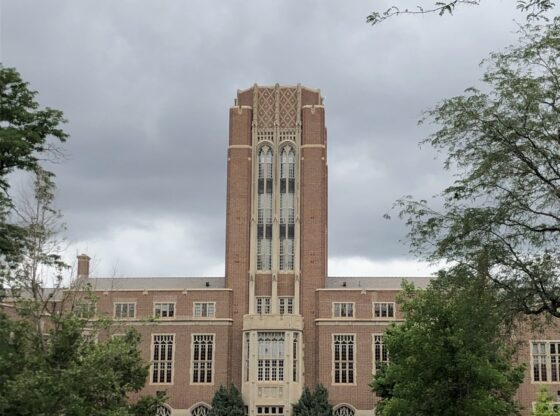
On Oct. 16, the University of Denver’s student body received an email stating that Chancellor Jeremey Haefner had signed the American Association of Colleges and Universities (AAC&U) statement on behalf of DU. The AAC&U had publicly declared they were in opposition to President Donald Trump’s Compact for Academic Excellence in Higher Education.
Haefner included Trump’s compact in one of his weekly “Reflections” emails, in which he stated that he stood with MIT and the AAC&U in their defiance to accept the proposed educational models put forth under the compact. Haefner’s reasoning behind this backing was that he felt “strongly that this is terrible for higher education,” as “free speech and academic freedom are critical to the discovery of truth and open inquiry.”
When reading over the compact, a clear ultimatum is laid out: comply with the administration or forgo federal funding.
This is not the first time Trump has tried to meddle in higher education by withholding funds. In March of this year, Trump declared that he would withdraw $400 million in grants to Columbia University because of the school’s failure to act against rising levels of antisemitism on its campus. To intensify the situation, this August, Trump signed an executive order, which vowed to thoroughly review every grant application to “ensure that they are consistent with agency priorities and the national interest.”
Since 1979, federal control over any educational institution’s curriculum has been prohibited under Title 20 Section 1232a of the U.S. Code. Yet this is not stopping one of the nine universities from considering Trump’s compact.
The University of Texas at Austin (UT) has reportedly considered being open to the proposal. Kevin Eltife, UT System’s Board of Regents Chair, said, “We enthusiastically look forward to engaging with university officials and reviewing the compact immediately,” while working closely with the Texas governor, Greg Abbott.
UT’s actions seem to already comply with Trump’s demands. Gov. Abbott confirmed that the university had fired Professor Art Markman from his administrative position due to “ideological differences.” Abbott made a public statement via X on Oct. 19 saying, “Texas is targeting professors who are more focused on pushing leftist ideologies rather than preparing students to lead our nation.”
An important distinction must be made: Trump is not protecting American free speech, rather he is protecting conservative speech.
Ten months into Trump’s second term, we have continuously seen assaults on free speech in every realm. Trump even went as far as to make a sly comment in a press release saying, “We took the freedom of speech away,” when referencing his executive order that bans the burning of the American Flag.
A healthy democracy is one where disagreements are welcomed. People should feel empowered to be able to voice their opinions, visions and critiques of the government, because after all, the institution is here to serve the people. Discourse thrives in higher education; its purpose being to expose us to different viewpoints and histories to help us create a wider, more colorful outlook.
The act of requiring universities to comply with the ideologies of the current administration to receive federal funding is a clear political move that works towards the creation of a homogenous thinking among young voters. Free speech is meant to protect the rights of all, and it is problematic for the current administration to attempt to legally protect one side at the expense of the other.