The elevators around the University of Denver’s (DU) campus have earned a reputation – and not exactly a flattering one. They’re more of a gamble than they are a convenience, known for trapping students behind stubborn metal doors or displaying their all-too-familiar “Out of Order” signs.
The elevator issues affect students across DU’s campus, but their impact isn’t felt equally. For one group in particular, the inconvenience goes beyond frustration and becomes a daily obstacle.
Picture your walk to class, assuming the building you’ve been sent to has a set of stairs, and assuming that you are not the person who takes the elevator one floor up — I trust those of you are taking the long route. Now add a heavy backpack, then throw an instrument case over your shoulder. Suddenly, those stairs look a bit more daunting.
For many students in the Lamont School of Music, that’s not a hypothetical – it’s their daily routine.
The Newman Center for the Performing Arts houses multiple concert halls and is also home to the Lamont School of Music. While the concert hall side of the building is equipped with several elevators, Lamont students are left with just one to access the academic side of the building.
The problem is that this single elevator is rarely operational. Auty Scherden, a third-year student studying violin performance, created the “Lamont Stairmaster Challenge” after experiencing firsthand the consequences of the broken elevator, and watching his peers navigate the same daily struggle.
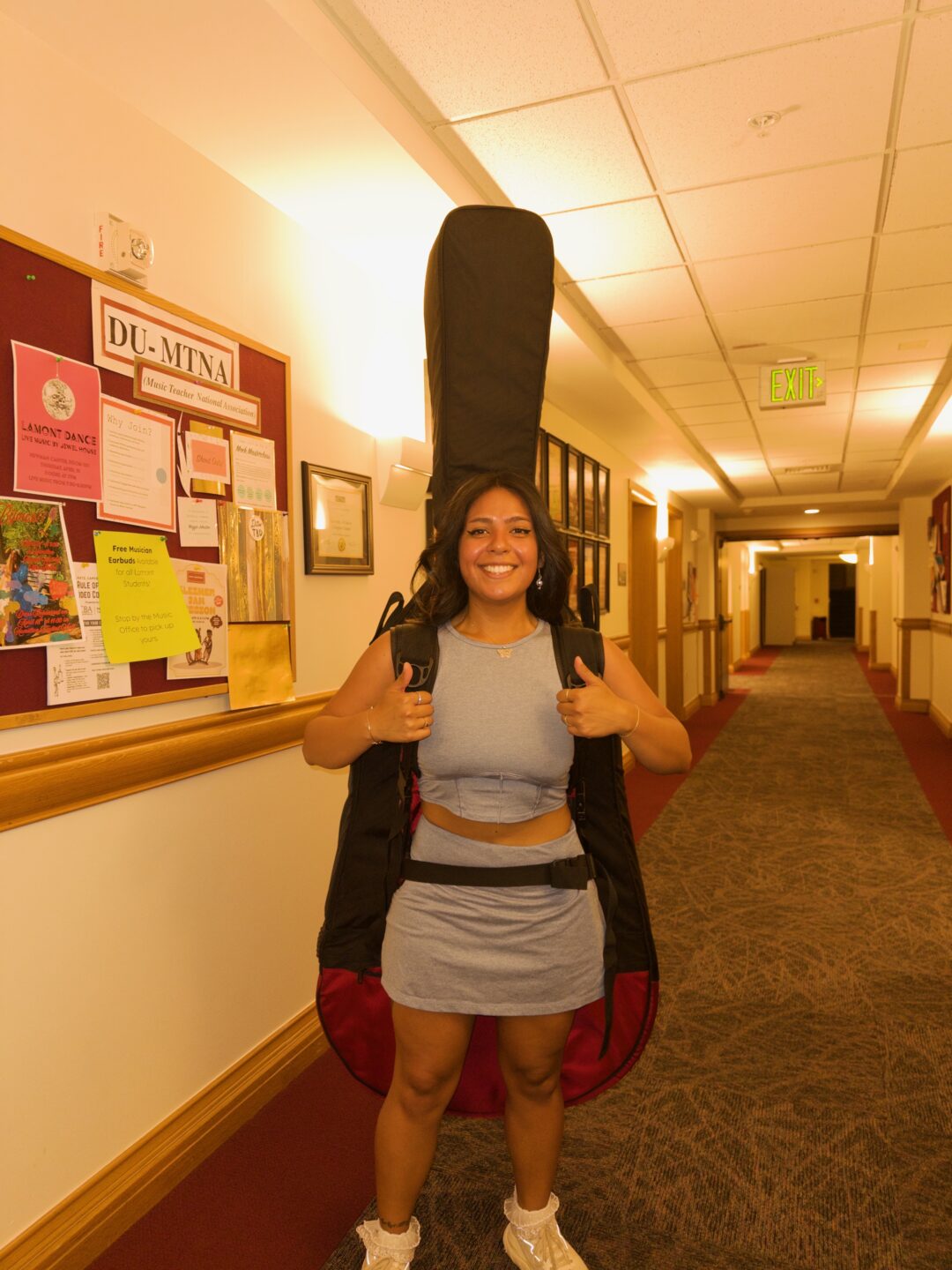
The struggle at hand is the three to five flights of stairs that come between students attending their classes, visiting professors or going to practice. Although this might seem a small feat, the addition of instruments on top of an already heavy backpack has made this a challenge for students.
“When I see my peers who have larger instruments, they have to take a break at every floor. It takes them ten to fifteen minutes to make a full trek and recover and be able to start practicing,” said Scherden.
Scherden mentioned a peer who struggles with asthma, noting that even one flight of stairs is hard on her lungs. ”When I see that she’s coming down the hall after going up the stairs with her inhaler in hand… I feel worried for my friends.”
The challenge took place on April 17, with Scherden welcoming more than 50 students and staff. Participants began on the West side of the building in the basement, climbed all five floors, crossed to the east staircase, and descended back to the basement to complete one lap. The goal was 22 laps, roughly 5,000 steps, with some students choosing to carry their instruments, counting each lap as two.
“We’ve [Lamont students] been talking about [how] we have increased lung capacity now. I thought I could turn it into a fun event that really boosts morale and also raises awareness about the lack of accessibility,” said Scherden.
According to the Americans with Disability Act (ADA), commercial buildings are required to have an elevator if they have three or more floors. At Lamont, there are five floors, demonstrating its accessibility issues. For students who rely on elevators to access their classes, the building’s sole elevator being frequently out of service raises concerns about maintenance and accessibility.
In an email statement to the Clarion, Jon Stone, the Director of Media Relations at DU stated, “The University is aware of the ongoing issue with the elevators in the Newman Center. Multiple repairs have occurred this year to maintain the safety and operation of the system, but due to its overall age, there are repeated disruptions. A full modernization of the Newman Center elevators is currently moving forward with the goal of completing the upgrade next academic year.”
The elevator has also become a source of frustration and humor within the Lamont community, with some students even placing bets on how long it will remain out of service.
Another hot topic is the past stories of both students and professors getting trapped within its iron walls.
“A close friend of mine was stuck in the elevator for forty-five minutes, which prevented him from getting to a performance,” said Scherden. “There is a faculty member who was a student in 2015 and he got stuck in the elevator between floors with a Marimba. He had to deconstruct the instrument and pass it to someone outside and then climb out.”
Stories of students and faculty getting trapped have become part of Lamont lore, but they also highlight ongoing concerns about accessibility on campus.
The Lamont Stairmaster Challenge brought attention to accessibility concerns within the Lamont community. While the issue may appear minor at first glance, some students say it has a broader impact on those who rely on accessible routes. Events like this reflect a growing level of student engagement around accessibility on campus.