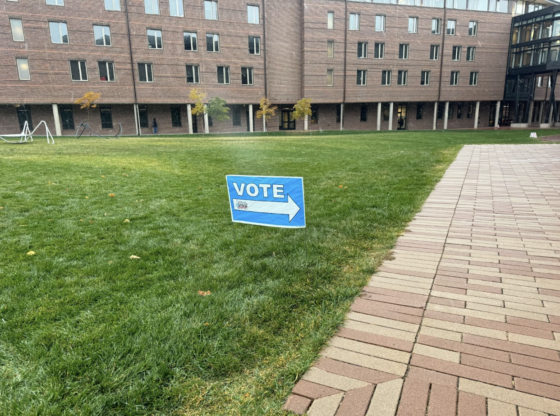
“Jeremy, Jeremy, we see you, no more predators at DU” was a chant that rang out among students at the “Fire Marco Nathan” protest on Oct. 22. Organized by the DU Student Union, the demonstration called for the philosophy professor’s dismissal following a Denver Post investigation.
According to the Post, DU’s civil rights office found Nathan responsible for sexually harassing a graduate student and recommended his termination, yet he remained employed by the university.
The sexual assault case was filed with Title IX last year, but the assault occured in 2024.
Currently the university has removed Nathan’s tenured status and claims he is no longer working directly with students, and instead is working off campus.
Organizers of the protest, Henry Horan and Rowen Taylor, said the DU Student Union is “calling for Nathan’s dismissal” and “increased funding and resources for the university’s Office of Civil Rights and Equal Opportunity.”
Horan is a senior at DU and president of the DU Student Union. Taylor is a sophomore and the organization’s vice president.
While Horan acknowledges that Nathan is no longer on campus he says that his continued employment “is a message to other faculty who might want to do harm, that they can do harm and still get their paycheck.”
The student union’s “goal is to make sure that students, faculty, staff, all community members at DU have their concerns represented, and that we have a university that is safe for everyone,” Horan continued.
“Our ultimate goal is to have a university that makes decisions in the interests of its community members, and we do not feel like it does that right now,” Horan said.
As for Title IX at the University of Denver, the student union believes that the organization needs more funding to adequately do their job.
During the protest speakers called out the discrepancy between the university’s Title IX office calling for the removal of Nathan, and the actual actions of the university to ignore those recommendations.
Horan said the student union spoke with the former student, who described difficulties navigating the Title IX process, including staff turnover and delays in communication.
“She wasn’t always talking to the same people. She wasn’t always getting responses with any amount of urgency,” Horan said.
These protests are coming off a year where DU had widespread faculty cuts in their humanities departments. Despite these cuts, Nathen has stayed employed and paid by the university.
In June, the university announced the closure of its Religious Studies and Electrical and Computer Engineering departments, alongside plans to combine several colleges and reorganize other departments.
According to Loboa’s announcement, up to 23 faculty members across the two closing departments could be affected. Options offered to those faculty included moving into other academic units, transitioning into a general service unit or pursuing retirement and buyout arrangements.
While the student union has not directly contacted administrators about these demands, they say they are working with other student organizations like student and faculty government representatives to get a solution.
Taylor said that these organizations have “better connections to the administration,” and could provide another avenue for raising their concerns.
The University of Denver told the Post “safety of students [is] a top priority,” but “due to federal privacy laws…the university is unable to provide details regarding this specific matter.”
In a statement shared through the Student Union, the former student extends “thanks to the student community for their advocacy on [her] behalf. It has helped restore [her] hope that there can be progress and change in higher education.”
This case arises amid broader scrutiny of how universities respond to sexual misconduct, including the “Cornell 7” case. A former Cornell University student filed a lawsuit in September alleging that seven fraternity members sexually assaulted her in 2024 and that the university failed to adequately address her case.
At DU, the student union’s demands reflect similar calls for universities to take stronger action against sexual misconduct and ensure that their responses prioritize the safety and concerns of students.
For the DU Student Union, moving Nathan off campus does not resolve its concerns. Organizers continue to call for his dismissal and increased resources for the Office of Civil Rights and Equal Opportunity, while working with other campus organizations to bring those demands to administrators.