The University of Denver (DU) announced a projected $20-30 million budget deficit for the next fiscal year, forcing administrators to immediately start planning widespread cuts across the school. These additional concerns follow significant budget cuts the university implemented during the previous academic year.
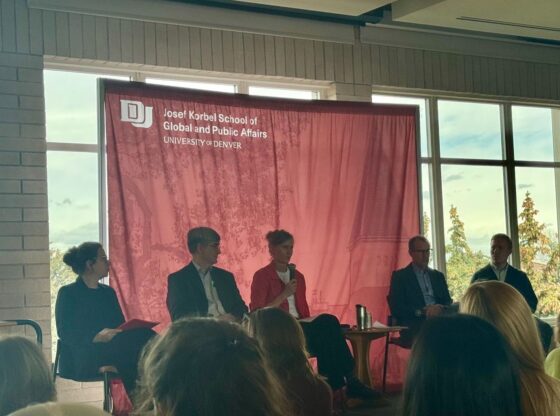
In a town hall meeting with university employees on Feb. 18, Chancellor Jeremy Haefner cited an “enrollment cliff” as the main cause of this deficit, with an abnormally large graduating senior class, and an incoming freshman class too small to fill the gap.
He also attributed a decline in international student enrollment to the Trump administration’s immigration crackdown.
“Washington is not our friend right now,” said Haefner.
Haefner and Provost Elizabeth Loboa described how the issue has compounded, with a cumulative $50 million decline in tuition revenue over the last four years.
“It has to go back to 2013,” said Haefner. “We were looking at the future of higher education and really saw the demographic cliff that was coming.”
At that time, then-Chancellor Rebbecca Chopp launched a ten year plan to address these issues, called DU Impact 2025.
The COVID-19 pandemic added another variable to this upcoming cliff. It caused the graduating class of 2026 to be abnormally large, which when paired with the current enrollment cliff has caused a steep revenue decline in the past three years.
“For the past three years we have done expense reductions, but not enough to keep in pace with the reductions in the revenue that has come forward,” Haefner said. “Now what we’re seeing is that the expenses are exceeding the revenues to such an extent that we no longer have surplus or the revenues we can dip into to safeguard the university moving forward.”
These factors have led administration and program deans to begin planning widespread cuts.
The main focus of these cuts will be on recurring costs to ensure that similar problems do not arise in the future, including faculty, staff and entire academic programs. The administration will also look to cut $10 million from non-academic units while transitioning to a three-year budget planning system.
Dean of the College of Arts, Humanities & Social Sciences (CAHSS), Sahara Bryne, was confident in the school’s ability to maintain the student experience despite budget cuts.
“The majors and minors currently offered in CAHSS are important to offer at a liberal arts institution and I will ensure that our students are able to study the topics that they came here to study,” said Bryne.
With the enrollment decline leading to a smaller student body, faculty and their classes will be cut to ensure that other classes are filling. Haefner, Loboa and Bryne have all referred to this process as “right-sizing.”
“There’s no nice way to say this,” Loboa said. “It will be hard.”
As well as reducing faculty and staff, the university has also temporarily stopped offering additional merit-based pay. To balance this, they have expanded employee benefits to include health insurance increases, vacation approvals, additional personal days and tuition exchange programs with partnering universities for their children.
There are no plans yet to reduce the retirement age to help offload employees. The current standards require that employees are at least 55 and have been working for 20 years.
Haefner’s salary was last reported to have raised from $922,734 in fiscal year (FY) 2023, to $1, 127,479 in FY2024, and he stated it will not be adjusted despite budget cuts.
“There is no intention to reduce salaries,” said Haefner, largely because “restoring [those] salaries is an unknown.”
Last April, an AAUP-hired external auditor found that faculty salaries were a relatively low cost for DU, while they overspent on administration compared to peer institutions.
At the Faculty Senate meeting on Feb. 13, DU employees were told that the university is currently evaluating all programs to see what could be cut and assess potential for mergers to reduce costs, despite some employee concerns that mergers may increase costs.
These decisions will be recommended by the “Goal 3 Committee,” whose goal is to “strengthen academic excellence.” Its subcommittee will be in charge of “Program closures and consolidations,” and will evaluate academic programs on five metrics: enrollment, retention, graduation outcomes, career outcomes, mission alignment, cost, revenue growth potential and course bill rate.
Due to the timeline outlined for notifying faculty members of an academic unit closure in the school’s Appointment, Promotion and Tenure (APT) policy, evaluation committees must submit reports to Provost Loboa by May 15. Loboa and Haefner will make final decisions and notify faculty impacted in June 2026.
This is a developing story. Expect more updates from The Denver Clarion.