Before I get on my soapbox, I should probably explain why I’m even writing this article in the first place. Sitting in my painfully early economics class, my professor started talking about “creative destruction” — the idea that new technology wipes out the old. Think Spotify replacing CDs. Or as my professor noted, the iPhone camera putting companies like Kodak out of business.
It was his last comment about the death of Kodak that sent my hand shooting straight into the air in defiance — and ultimately what sparked the idea for this article.
See, I’ve been shooting on film for a little over a year now, and I can confidently say I love it more than any digital format I’ve ever used. Maybe that makes me biased as a photographer. But physical media as a whole? That’s definitely not dead — especially not among college students.
It’s this age of instant gratification driven by new technology that is pushing people back toward older forms of media. With film photography, the process becomes far more intentional. When you only have a limited number of shots on a roll, you start thinking carefully about what’s actually worth documenting. Instead of endlessly spamming the capture button on your phone and filling your camera roll, each image feels deliberate and more meaningful.
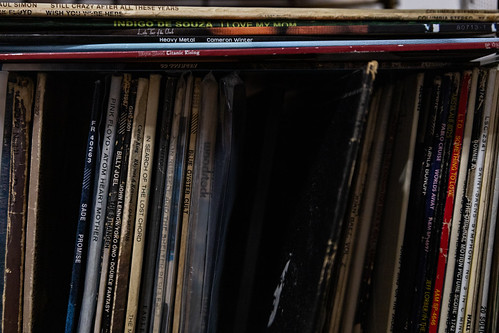
Despite what my professor may say, our generation still craves tangible things. We still buy records, even though we could easily stream the music. We read physical books opposed to opting for an audio book or an online PDF. I’ve taught more people about film photography this past year than I can count. There’s something comforting about learning a form of art opposed to quickly snapping a picture on your trusty iPhone.
This is coming from a person who takes an embarrassing amount of pride in their record collection, but I refuse to believe I’m alone. Though I may not be an objective voice, the LA Times found that in 2025 there was a 9 percent decline in physical media sales, compared to a 20 percent drop in 2023 and 2024 sales. It’s not just me — physical media is making a comeback.
Let’s discuss vinyl. This is in fact when I hop on top of the aforementioned soapbox and speak to anyone that will listen — our readers in this case.
A record can run you anywhere from $20 to $40 if you are buying it new. When there are so many cheaper and more convenient ways to listen to music, why would anyone choose the expensive route?
“I like to have a physical manifestation of the music I love, I want to be able to pass it down to my children one day,” said Kiana Panah, a senior studying Environmental Science at the University of Denver. “Normally I find them [vinyl] at estate sales, it’s more sustainable and it feels rewarding when I find a record I love.”
Having a physical manifestation of your favorite music is certainly part of the appeal. But there are plenty of other reasons people choose to buy records. The first being that the music sounds better. I can practically see the eye rolls as I’m writing this, but hear me out.
If you sit down and truly listen to the difference your favorite song sounds on vinyl versus your phone, vinyl wins hands down. The analog sound waves can feel fuller and warmer, producing a nostalgic sound you won’t experience with your phone.
This isn’t just my opinion, it’s science. The analog sound waves produced by records can preserve subtle details that sometimes get lost when audio is compressed and converted into digital signals for streaming. Those small losses in data don’t necessarily ruin the music, but they can change the texture thus shifting how it feels to listen.
The other major plus of buying vinyl is experiencing an album in its entirety. In the age of Spotify and Apple Music, playlists consisting of songs taken from numerous albums are built for convenience rather than cohesion.
Albums are meant to be listened to in the order the artist intended. Similarly to the immense thought put into each song, the order you hear them in is just as important.
Vinyl is a key example of Gen Z’s growing affinity for physical media, with one study finding that vinyl album sales increased by more than 300 percent, rising from 13.1 million records sold in 2016 to 49.6 million in 2023.
Sure, streaming music is easier. Your iPhone camera is more convenient. But convenience has never been the same thing as connection. There’s a reason college students are digging through record bins, learning how to load film into old cameras, and spending money on objects that were destined to fall victim to creative destruction years ago.