Editor’s Note: Statements made by Aya Saad-Masri, Michela Schenk, Owen Mantelli, Ben Merson and Madeleine Dierking were made in their personal capacity as students, and any references to their roles in Undergraduate Student Government (USG) were made without invoking their official title or authority. Their statements were not made on behalf of the entire USG, or any branch or committee of USG.
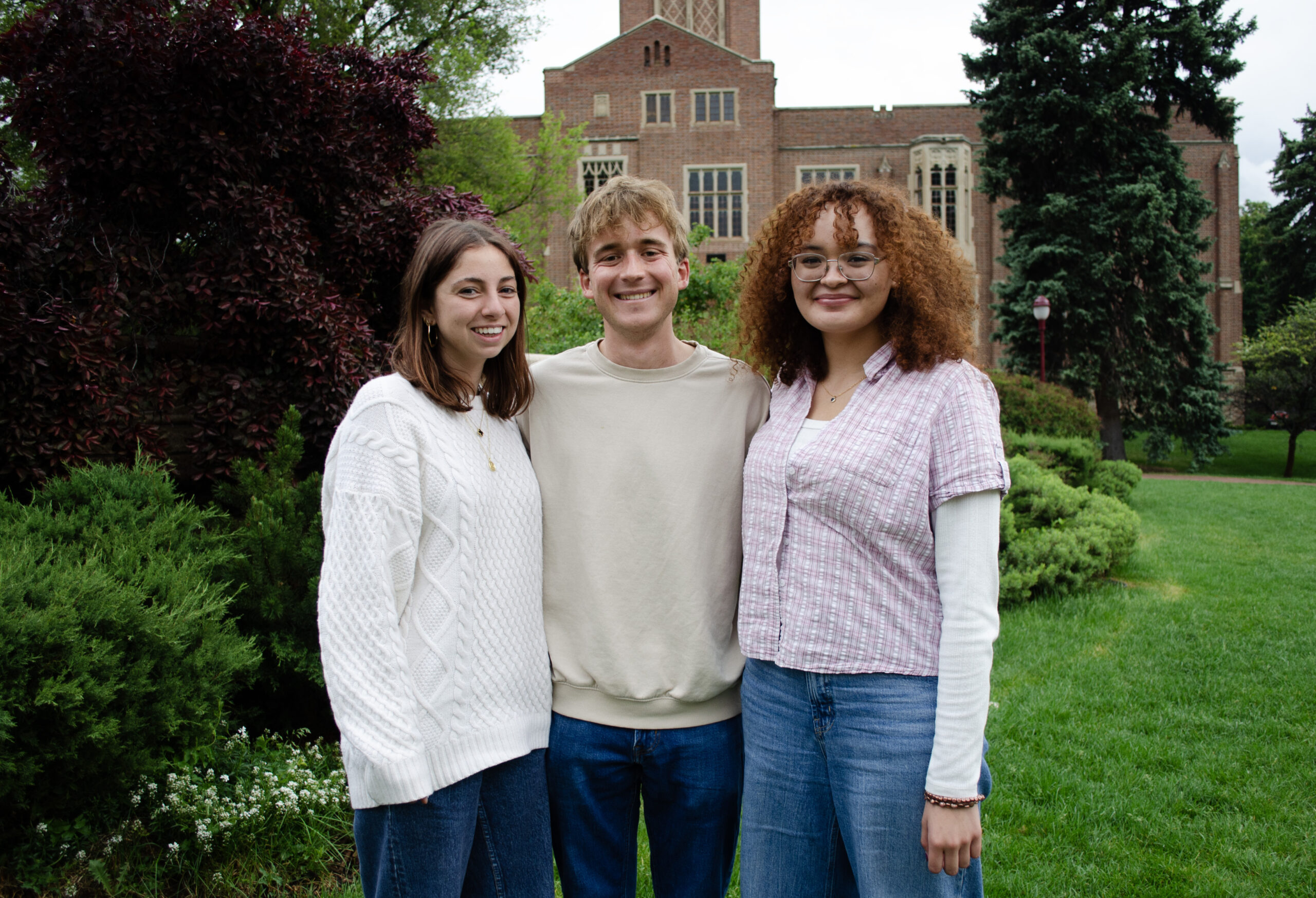
Polls for the upcoming presidential and vice presidential elections for the Undergraduate Student Government (USG) will open on May 4. Ahead of the debate on May 1, The Denver Clarion spoke to three teams that have declared their candidacy to learn more about their backgrounds, the issues they plan to tackle and what they believe sets their ticket apart from their peers’.
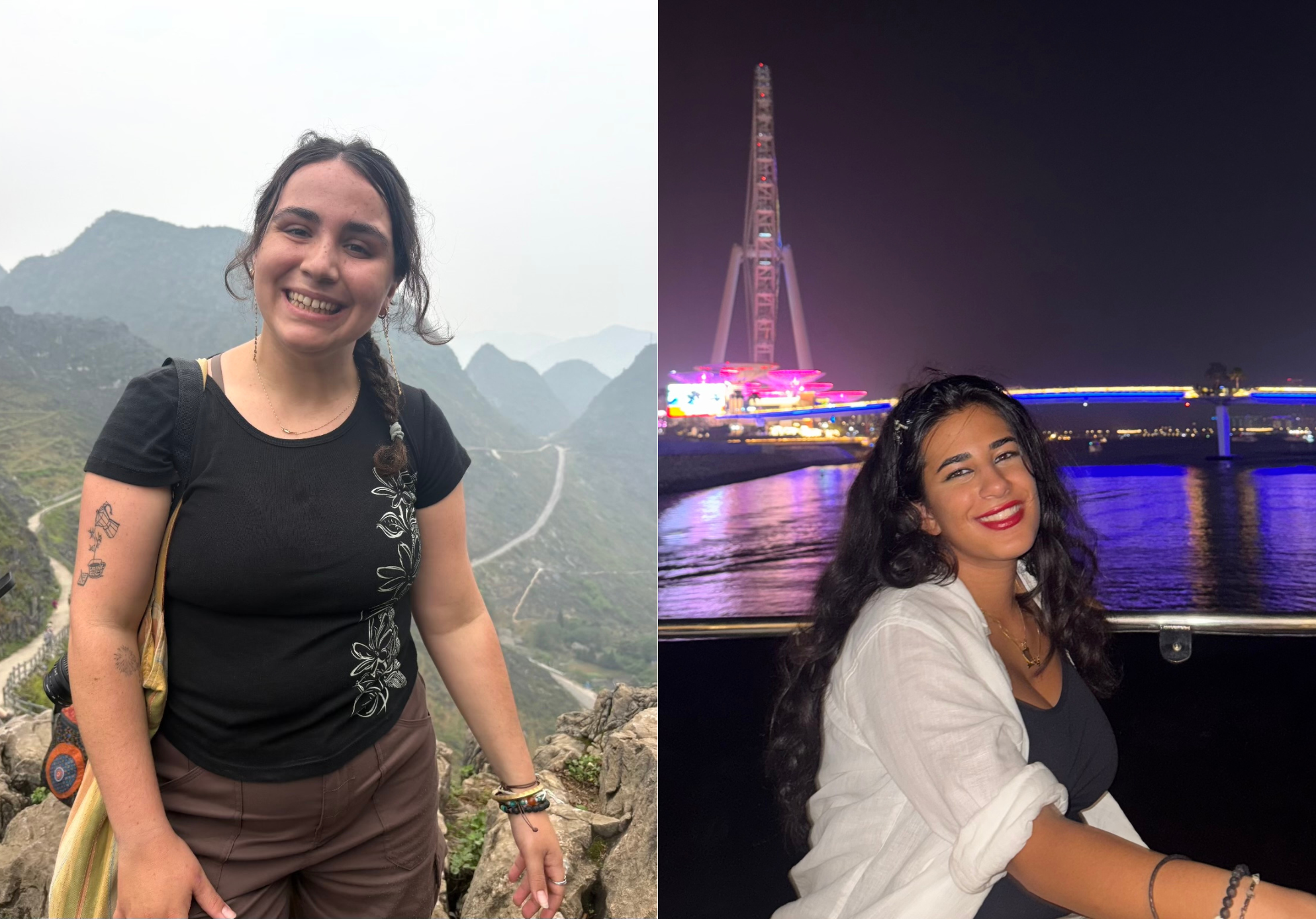
Aya Saad-Masri and Michela Schenk are running for president and vice president with an array of leadership experiences behind them.
Third-year Saad-Masri, who joined USG last year, has held roles ranging from executive leadership to study abroad senator and chair of the student organizations committee. She is from Denver and is majoring in international studies and socio-legal studies with minors in Middle Eastern studies and leadership studies.
Schenk, also a third-year student, served last year as the senator for natural sciences and mathematics on USG and has worked on campus safety initiatives, sustainability efforts in dining halls and career programming for STEM students. She is from the Chicago suburbs and is majoring in environmental science and history with minors in leadership studies and international studies.
Outside of USG, both have also taken on leadership roles in academics and campus life, including teaching assistant positions and student organization leadership.
Saad-Masri and Schenk met in USG during their second year and quickly became friends. Now, they have teamed up to run for USG president and vice president.
Through their A.D.V.O.C.A.T.E. platform, the pair seeks to address what they see as a lack of community across campus by better supporting underrepresented groups and bringing students together.
Saad-Masri identified how students of color, particularly Black and Latine students, often feel disconnected from the broader DU community. She noted that some organizations like the Muslim Student Association (MSA) are highly active but underrecognized on campus.
She also pointed to a disconnect between students who are deeply involved in campus life, such as those in Greek life or on-campus housing, and those who are not — particularly commuter or transfer students.
As a commuter student herself, Saad-Masri is acutely aware of this disconnect.
“Many [commuter] students struggle to feel integrated into DU’s social and institutional structures,” said Saad-Masri.
The team plans to rethink how and when campus events are held and ensure that student organizations are more inclusive in their outreach.
They’re proposing more flexible programming, such as daytime events and alternative meeting times for student organizations, which would better accommodate students with jobs or off-campus responsibilities.
Their platform emphasizes “dialogue and openness,” but both candidates stressed that these ideas must translate into concrete action. Saad-Masri proposed reinstating leadership roundtables that bring together leaders from student organizations, Greek life and athletics to discuss shared challenges and communicate them directly to university administration.
Schenk believes USG’s past efforts at improving dialogue between students and administrators have fallen short in many cases.
“What I think we had going in most of our Senate conversations with admin was a lot of… just listening,” Schenk said. “However, dialogue can include you asking hard questions to admin… It’s our job and our duty as representatives of the student body to push, not just listen.”
Both candidates also addressed student criticisms that USG’s actions and initiatives can feel unresponsive or symbolic. Saad-Masri said their administration would focus on clearly defined, achievable goals that are already in motion, rather than broad or abstract initiatives.
“The biggest impact… is outlining tangible goals that are already in motion. We need to come in… with a built upon, improved framework on tangible goals that we can achieve as our administration,” said Saad-Masri.
They plan to organize early-year mixers between senators and college deans to establish relationships and reduce bureaucratic barriers that can limit effectiveness. This will ensure that new members of USG will be able to adapt quickly to their new roles.
Schenk has spent her third year studying abroad in Granada, Spain. When asked whether this may leave her out of touch with campus, Schenk argued that the experience has strengthened, rather than weakened her candidacy.
“I truly think that being gone for a year isn’t a detriment to my work in USG—I think, if anything, it’s been beneficial.”
After studying at multiple universities, including the Universidad de Granada, she said she gained new perspectives on how student governments interact with administration. She plans to return to campus early and actively reconnect with student organizations.
Ultimately, Saad-Masri and Schenk say what distinguishes their ticket is a commitment to bridging the gaps between students and administrators.
You can learn more about Saad-Masri and Schenk’s platform and follow their campaign at @saadschenk.for.du on Instagram.
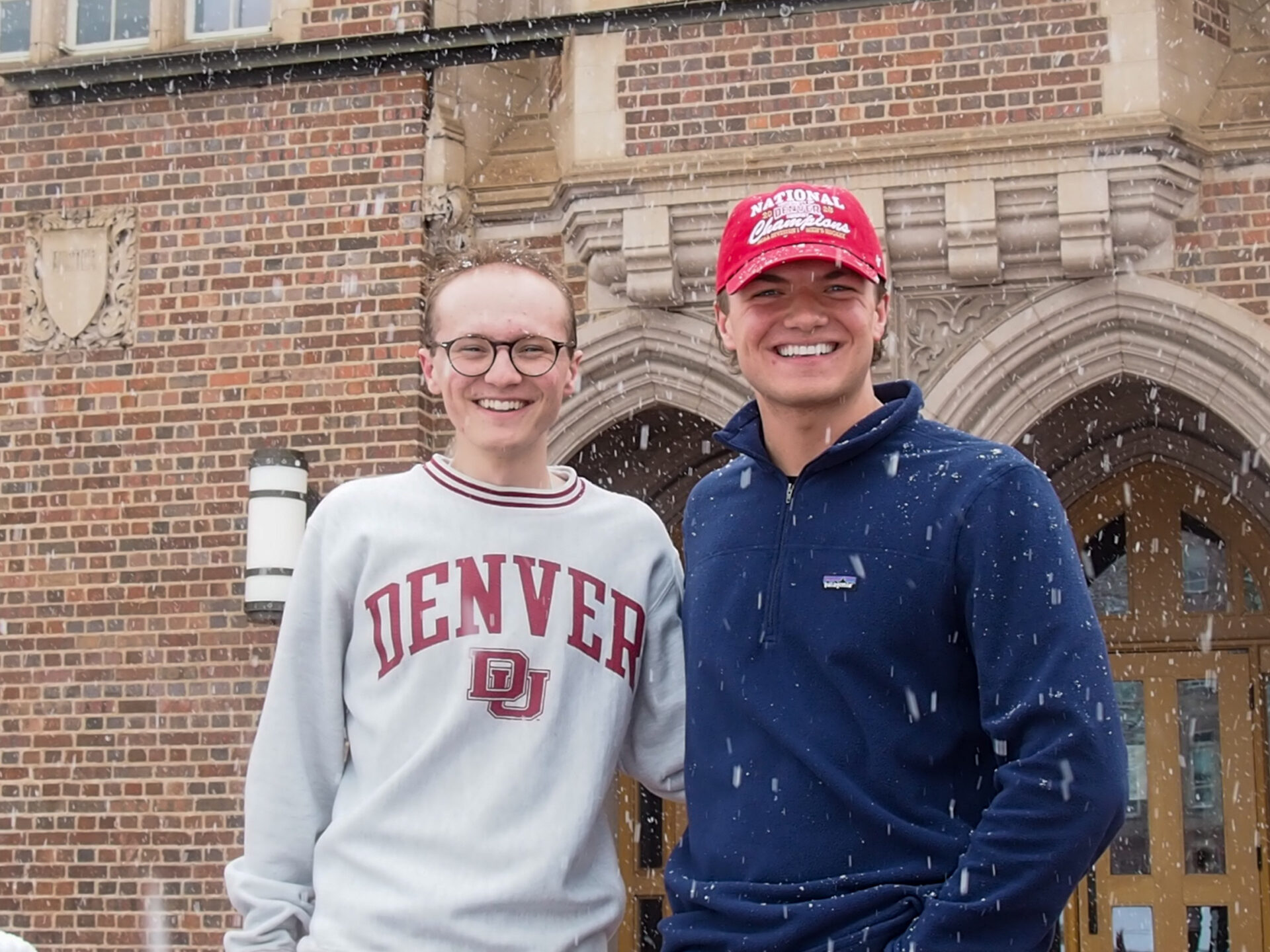
Third-year political science major Owen Mantelli from Castle Rock, Colo. is running for USG president alongside second-year accounting major Ben Merson from Centennial, Colo. Mantelli has minors in media, film and journalism studies (MFJS) and leadership studies, while Merson is minoring in chemistry.
Mantelli and Merson met in USG, where they currently serve as vice president and justice primus respectively. Mantelli was the president pro tempore at the beginning of the year, and stepped into the vice presidential role when Noura Ali Abid went abroad at the beginning of spring quarter. He has also served as a junior senator and an on-campus senator.
Merson was an associate justice on USG’s judicial branch last year and he was also a Transfer Student 4D Peer Mentor. Alongside his experience in USG, Mantelli is also a DU tour guide, and cited their experience in USG and other on-campus initiatives as a key advantage in the race.
“We’ve worked very closely with President Ethan Turner and former Vice President Noura Ali Abid,” Mantelli said. “I think that’s part of why we’re the best ticket, because we have the experience. We’ve been doing it and we can actually say, ‘here’s what we can get done in a year’s time’.”
They plan to rely on the relationships they’ve built in and outside of USG to enact changes on campus.
“One achievement that we’ve had this past year, in partnership with the campus management committee and hall councils, is that we were able to move winter quarter move-in from Sunday to Saturday,” Merson said. This transition will be in effect starting next academic school year.
“It’s actually a serious expense for the university to do that… and I think it’s a good sign of what we can accomplish,” he said.
“It’s about leveraging those partnerships correctly and identifying specific issues that students wanted to see fixed, bringing them to those campus partners and walking away from those meeting, not just saying that we’ve shared the concern, but going a step further and saying we’ve shared the concern and here are the next steps,” Mantelli said.
Mantelli and Merson’s campaign focuses on three pillars that they describe as the “missing pieces” of the student experience at DU: spirit, wins and feedback.
“There’s a huge focus on academics and everyone here is really involved in their classes, which is great,” Mantelli said, “but where are we really having fun on campus? I think that’s the biggest place where USG can actually make a huge difference.”
Their platform emphasizes increasing school spirit by creating new traditions and improving merch. They’re also seeking to improve housing and dining conditions on campus.
“Where are people living and what is the quality of housing? What are people eating, and what is the quality of the food?” Merson said. “I think we would be remiss not to run on a platform where we’re meeting student needs in those areas because we know that’s one of our weak ones as a university.”
Despite the crowded ballot, Merson and Mantelli believe their ticket is uniquely positioned to advocate for the student body. Merson noted that himself and Mantelli have classes in different colleges across the university.
“I think we represent quite a broad constituency,” Merson said. “That really diversifies our ticket.”
Another element that the candidates believe sets them apart is a commitment to only pledging what they can realistically deliver.
“We’re only going to make promises we know we can get done,” Mantelli said. “These terms are short, and the transition period can take a long time. We don’t have to worry about the transition period as much as other potential presidents and vice presidents would have to. ”
“Anything we’re promising to you right now, we’re going to work on, and it’s going to have tangible effects on the student experience here at DU in a positive way,” he concluded.
You can learn more about Mantelli and Merson’s platform and follow their campaign at @mandm4du on Instagram.
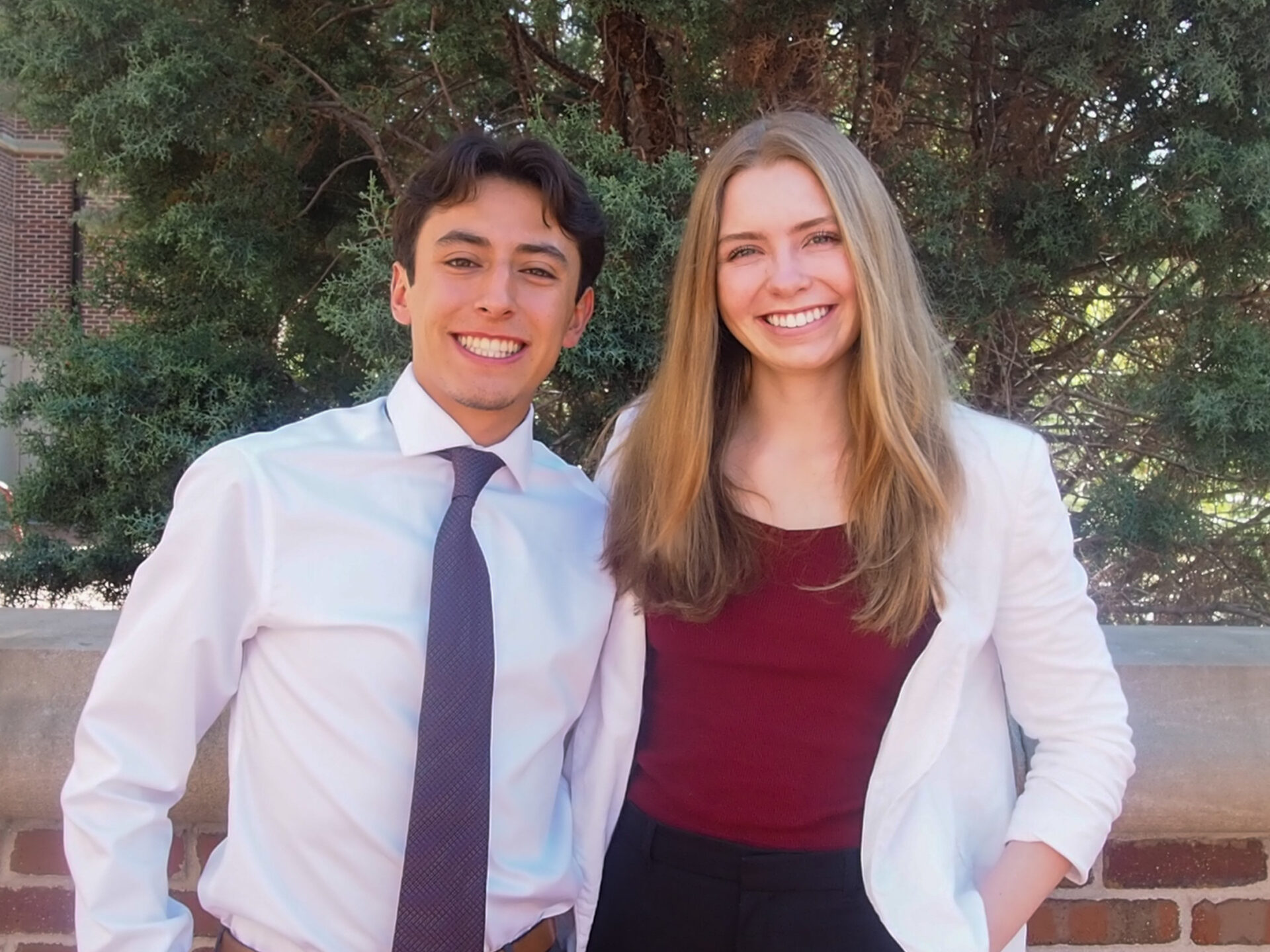
Presidential candidate Madeleine Dierking, from Superior, Colo., is a third-year finance major with minors in political science and leadership studies. She’s running alongside vice presidential candidate Justin Walker, a third-year psychology and political science major with minors in business ethics and legal studies from Fort Worth, Texas.
Dierking is seeking to extend her tenure to a fourth year as part of USG, having previously served as a freshman senator, a senator for the College of Arts, Humanities and Social Sciences (CAHSS) and a junior senator. Last year, she chaired the student living, safety and wellness committee. Dierking highlighted the different ways in which she’s advocated for students during her time in USG.
“Freshman year, I saw a couple of Fizz posts that students wanted an ice cream machine in the dining hall. I went out and I met with donors and facilities, and we got an ice cream machine in the dining hall,” Dierking said. “To me, USG creating tangible change is very important.”
Dierking also worked to improve the relationships between Campus Safety and affinity groups and pushed for campus safety officers to receive training so they are better prepared to work with neurodivergent students.
Dierking is also a tour guide and Career Peer Advisor at the Burwell Center. Walker is the treasurer for the Native Student Alliance (NSA) and an intern in the Office of Admissions. He has also been a resident mentor and tour guide. Walker is the only declared candidate thus far without experience in USG, though both he and Dierking believe this is an asset.
“A lot of people in USG are siloed. Whereas for me, I’ve been able to make change in various departments, from admissions to new student family programs to housing,” Walker said.
He also noted that he’s been taking steps to learn more about how USG operates, including reading its bylaws and attending meetings, as well as talking to former Vice President Berkeley Rebman, who also won without any prior USG experience.
Dierking highlighted the advantages of having a ticket composed of both a seasoned USG representative and a candidate from outside the organization.
“USG is such a minority percentage of the actual student body,” Dierking said. “It’s important to know what’s happening in USG and it’s important to understand the structure, but he’s a better representative of the actual student body.”
She added, “I think the two of us provide both the structure and the creativity that makes us a really strong partnership. I think it’s phenomenal that he’s from outside USG and provides that fresh perspective and representation.”
The three pillars of Dierking and Walker’s campaign are transparency, advocacy and pride.
“We feel like a lot of students don’t understand what USG is and what they do,” Walker explained.
“When we were campaigning and grabbing signatures, we asked what students wanted to change,” Dierking said. “So these pillars aren’t just… what we think will be best, it’s actually from the entire student body.”
Dierking noted that the students they spoke with were concerned about the increasing cost of tuition and where that money is actually going. The issue is now part of their campaign’s transparency pillar.
Dierking and Walker argue that their campaign’s strength is ultimately grounded in what they’ve already proven they can achieve.
“Anyone can run on a platform of transparency, advocacy and pride, but how have you actually done it in the past, and how do you plan to do it moving forward?” Walker said. “We’ve really made an impact on a smaller scale, making people feel seen, valued and supported, giving them the right resources, and encouraging them to use their voice to make change. So this isn’t a platform of something that we think will work, it’s a platform that we know will work because we’ve done it in the past.”
You can learn more about Dierking and Walker’s platform and follow their campaign at @tap4du on Instagram.
Look for more coverage of USG elections from The Denver Clarion, including coverage of the debate on May 1. Potential presidents and vice presidents have until April 24 at 11:59 p.m. to declare their candidacy. Those who declare closer to the deadline will be covered in future reporting.
Voting will begin on May 4 at 8:00 a.m. All students will receive an email with a Qualtrics Form at their university email addresses.