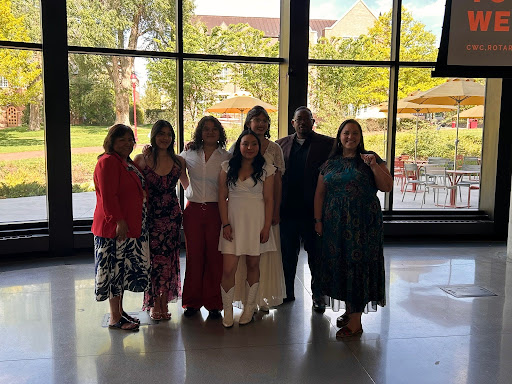
On Jan. 26, Wolzien Visiting Professor of the Practice in Research Informed Communication, Laura Frank, received the Governor’s Citizenship Medal for Public Service, the state’s highest recognition for civic leadership and service.
Frank received the award for her contributions to journalism, while also highlighting her role as executive director of the Colorado News Collaborative (COLab). Her work connects newsrooms across Colorado to stay engaged with pertinent topics and to redefine local journalism.
“It was the honor of a lifetime and a surprise to receive it. Nothing I have done, I have ever done alone. I was surprised to be singled out in that way, but I was most thrilled to receive the recognition that journalism is a public service. To have all the living governors recognize journalism as a public service is one of the most important things I have ever witnessed,” said Frank.
Prior to her work with COLab, Frank started her career as an investigative reporter at Rocky Mountain News. She covered sick nuclear weapons workers who were denied government compensation for their service and wrote articles that helped free incarcerated individuals from prison.
“I got into the business because I had a deep desire to help reveal the truth. What has kept me in it is the impact that a truly reliable news source can have on a community,” said Frank.
When Rocky Mountain News closed in 2009, Frank started a nonprofit news service called The Rocky Mountain Investigate News Network which transitioned into the Institute for Nonprofit News (INEWS). INEWS now has over 500 news organizations across the country and provides trustworthy news to communities.
After INEWS merged with Rocky Mountain PBS in 2013, Frank took over the investigative documentary unit. After seven years with Rocky Mountain PBS, Frank developed the idea of COLab which launched in 2020. COLab is a nonprofit that works with nearly 200 news organizations across the state to strengthen newsrooms by using community engagement and evolving business practices.
“We help news organizations work together on coverage of elections and implementing tech tools. We are helping bring people together to talk about the role of journalism in their community,” said Frank.
Frank’s position at DU allows her to connect students to experiential learning.
“At DU, through the Wolzien position, we are piloting the Media Academia Talent Collaborating to Help (MATCH) lab. The lab works with professors and their students to bring in people from Senior Corp of Retired Executives (SCORE) to help news organizations address real-life challenges,” said Frank.
The piloted MATCH lab program is having real impacts in newsrooms. In collaboration with MFJS Professor Erika Polson’s Capstone marketing class, the Aurora Sentinel created a new paid position.
Frank’s inaugural MATCH lab class created a “Post-Pantry,” a library of social media templates designed to streamline published articles into social media content. The project allowed the Sentinel to reduce the amount of time spent per post from 40 minutes to four minutes. This extra time allowed the publication to create a new TikTok account.
After the results that COLab and the DU MATCH lab are having on news organizations, nearly 15 other universities want to implement this program.
After receiving the Governor’s Citizenship Medal for Public Service, Frank’s desire to help local journalism thrive is far from over. She has created an innovative and necessary organization and wants to continue to develop COLab and MATCH to further transform news organizations.
“I hope my students take away that they can solve real problems, and they bring intelligence and empathy to an industry that needs both. Work has never been more important than it is right now,” said Frank.