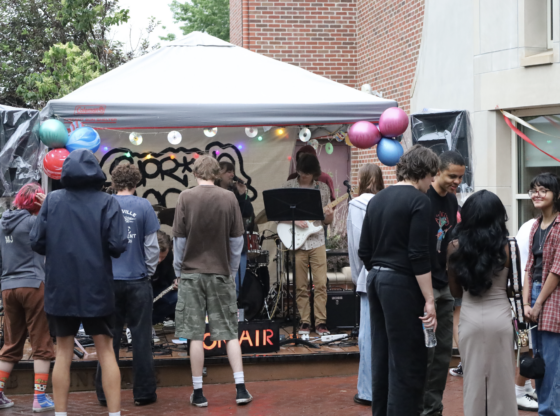
This past week, the Lamont School of Music showcased its Percussion Ensemble. While primarily focusing on percussion, this performance contained a multitude of sounds and rhythms.
The musicians showed off all aspects of the percussion stage with strong beats that you could feel in your chest. They ended the night with a group improvisation featuring a variety of drums, creating a captivating groove.
There was a lot of creative freedom with this band, making the performance fun to watch and more interpretive than a full ensemble. They opened with the classic flick of a lighter, turning an everyday object into rhythm and immediately grabbing the audience’s attention.
“Vous avez de feu?” by Emmanuel Sejourne was performed with four people and eight lighters with the auditorium lights dimmed. The simplicity of the performance reminded everyone that percussion and meter surround us every day.
After hooking the audience’s attention, the lights came up and five of the members began a lively piece called “Sharpened Stick” by Brett Dietz. This is a Native American war song blended with the “fish-step,” which is a rhythmic stomping dance.
This dance influenced “The Charleston” in the 1920s. The song had a strong driving beat with a theatrical shout by the performers that mirrored a traditional call from the Native American cultural aspect of the piece. The performance was both visually and aurally dynamic, making the percussionists work together.
“Sculpture in Wood” by Rudiger Pawassar was delivered through four marimbas. The name of this piece emerges from this song because of the warmth of the wood and the texture of sounds from the different marimbas. Similar to a sculpture, a marimba can demand its own line of notes that glide in one ear and out the other. Together, the four musicians took this classic A-B-C-A form to a new level of cohesion.
Moving back to a more traditional percussion sound, three of the musicians performed the three movements of “Trio per Uno” by Nebojsa Zivkovic. The first movement was powerful with a shared bass drum between the three players. It was sharp and aggressive that caught everyone’s attention.
The second movement was a complete switch-up, transporting the audience into a whimsical trance. They played softer drums along with small symbols and more incorporation of unique percussion instruments.
They ended strong on the third movement, which felt wild and high energy with a lot of coordination from the ensemble. The three movements brought contrast to the performance and complex rhythms. The outer movements brought chaos to the stage, with the middle acting as a moment of reflection and time to soak in the blend of instruments.
Lastly, director Michael Van Wirt brought the entire ensemble out for a final performance called “Kumpo.” This piece, inspired by West African rhythms, featured a vibrant percussion performance with lots of hand-held drums that molded the song together.
With all the musicians on stage, they each had an opportunity to improvise, allowing for creative freedom and a more colorful sound. Typically driving the band, the percussionists pushed one another to create beats stronger than the last.