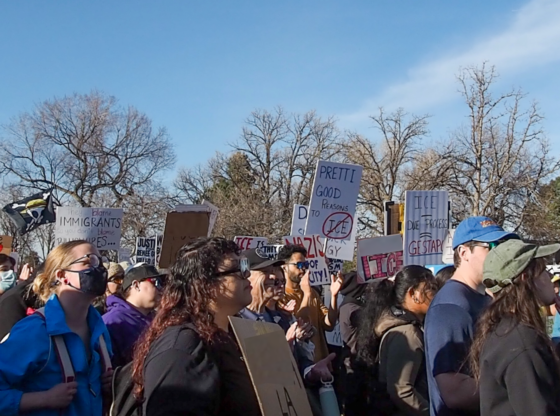
On Feb. 26, Denver Mayor Mike Johnston signed an executive order to limit the activities of Immigration and Customs Enforcement (ICE) in the city.
This comes as a study ranked Denver among the cities with the largest increases in ICE activity since the beginning of President Donald Trump’s second term.
Executive Order 152 holds that unregulated ICE operations pose a risk to individuals and the broader community, saying its purpose is “to protect Denverites from unconstitutional and dangerous federal operations.”
The order bans ICE officials from using city property to plan or conduct operations, “unless the immigration officials have obtained a valid court order, judicial warrant, or as otherwise required by law.”
It also instructs “Safety Agencies,” including the city Police, Sheriff and Fire departments, to document ICE operations, conduct investigations when necessary and “de-escalate potential conflicts with members of the public and law enforcement personnel.”
The order also restricts ICE from stopping individuals based on perceived racial and ethnic identities.
The Department of Homeland Security (DHS) and legal experts have questioned the legality of the order and the plausibility of enforcing it.
In a press statement, DHS called the order “legally illiterate,” denying that the city has the constitutional authority to ban ICE agents from public property. The statement reads, “Enforcing federal immigration laws is a clear federal responsibility under Article I, Article II and the Supremacy Clause.”
Following the executive order, Denver has taken additional steps to further limit how ICE operates within the city.
On March 2, the city council voted unanimously to pass a law to restrict ICE agents from wearing face coverings, following other U.S. cities that have implemented similar legislation.
Prior to the law’s actualization, DHS stated its opposition to the measure, saying that it posed a threat to ICE officers’ safety.
It is unclear if the ban will be enforced by the Denver Police Department.
The Denver Public School Board recently proposed a policy that designates school property as “Safe Zones.”
The proposal outlines rules of conduct for school-related community interactions with ICE.
The measures largely involve protecting student information. One states that employees shall not “collect, maintain, or disclose information regarding the immigration status of students, families or employees, except when explicitly required by a court order or by State or Federal law.”
As ICE activity continues to concern communities across the nation, Denver is prioritizing setting boundaries for the organization.